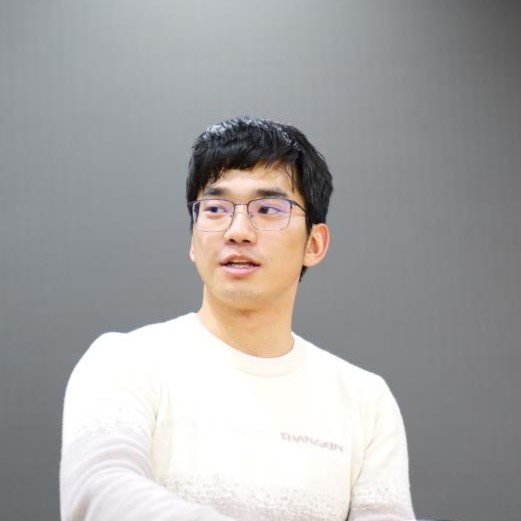
Peng Jiang 蒋鹏
PhD Student, Computational Neuroscience · Tsinghua University
About
I'm a PhD student in Computational Neuroscience at Tsinghua University, Beijing, supervised by Prof. Xiaoxuan Jia in the Neural Coding Lab. My work sits at the intersection of neuroscience and AI, to understand how intelligent systems (brains and models) represent, reuse, and generalize knowledge.
Currently I am working on Neural Foundation Model research, to build large-scale pre-trained models for neural spiking data, which can generalize across brain areas, sessions, and subjects. The goal is to understand how information is represented and encoded in the brain, and how neural activity can be decoded into behaviors and visual experiences such as images and videos.
Previously, I explored startup opportunities in the area of real-time interactive digital humans.
Research Interests
Education
PhD, Computational Neuroscience
Tsinghua University · Supervisor: Prof. Xiaoxuan Jia
B.Sc., Life Sciences (Minor: Computer Science)
Tsinghua University
Academic Experience
Multi-task Neural Representation Research
Neural Coding Lab, Tsinghua University
- Analyzed multi-task neural representations across brain regions using invasive Neuropixels recordings from mice
- Built multi-area RNN models to study hierarchical task representation in flexible cognition
- Investigated compositional generalization of task representations via continual learning with LoRA fine-tuning of LLMs
NeuroHorizon: Long-Horizon Forward Prediction of Neural Population Activity via Autoregressive Decoding with Hierarchical Memory
Submitted to NeurIPS 2026 · Under review
- Studied long-horizon forward prediction of neural population activity
- Developed an autoregressive encoder-decoder model with event-level spike tokenization and hierarchical tail+segment memory
- Evaluated multi-step rollout stability across motor- and visual-cortex datasets for scaling and generalization
Entrepreneurship
Co-Founder & Algorithm Lead
Startup · Leave of absence from PhD
- Took a leave of absence from PhD study to co-found a startup
- Built a real-time, audio-driven interactive digital human system based on 3D Gaussian Splatting (3DGS)
- Maintained the full algorithm pipeline, including multi-camera capture calibration, 3DGS-based head reconstruction, and diffusion-based audio-to-expression driving